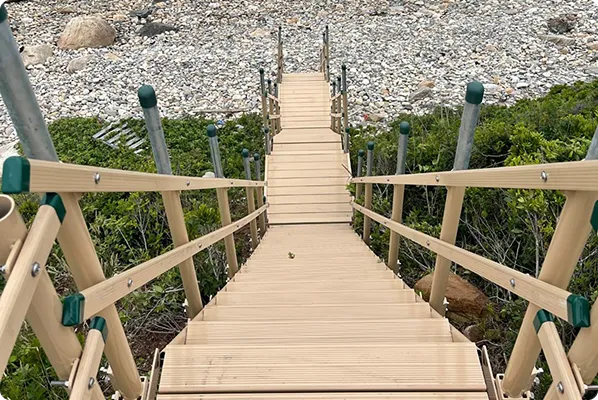
Why Alummikon: Stairs for Banks Too Steep, Rocky or Remote
Forty feet of drop down to the water. Ledge halfway down. A bank that changes pitch three times between the lawn and the shoreline. For most contractors, that is a job they walk away from: excavation, forms, concrete, a crew for a week, an engineer, a permit fight, and a price the owner will not sign.
That is not a hard job. That is a job nobody built the right part for. The Alummikon All Terrain Stair was built for exactly that bank.
The four walls every waterfront stair job hits
Almost every difficult waterfront stair job dies on one of four things. Here is what each one is, and what the All Terrain Stair does about it.
| The problem | Why it stops a job | What the All Terrain Stair does |
|---|---|---|
| Too steep | Stock stairs come in a fixed pitch. The bank does not care what pitch you bought. | Rise adjusts 4 to 9 in, and pitch adjusts through the entire run, not just at the front legs. |
| Too rocky | Ledge means no footings. No footings means no concrete stair. | Pipe is driven where it can be, and bearing feet are set on the stone where it cannot. Nothing is poured, dug or welded on site. |
| Too hard to permit | Anything permanent in a shoreland zone turns into a hearing. | The stair comes apart. Removability is what gets it through review where a poured stair never would. |
| Too hard to get to | No equipment access, no staging, no truck at the water. | It ships as a labeled kit and goes together with hand tools. One crew, one day on a typical run. |
Eleven custom dies
Most companies in this business buy stock aluminum shapes and bolt them into something. Alummikon had its own dies cut, eleven of them. Every extrusion in the system exists because a bank needed it to, not because it was available off a shelf.
That is why the stair can follow ground a catalog stair cannot.
The engineering behind the stair
| Item | Specification |
|---|---|
| Code basis | IBC 2021, ASCE 7-16 loading |
| Live load | 100 psf, stair and platform |
| Wind | 117 mph |
| Engineering | Stamped calculation for the stair system; Sullaway Engineering is the engineer of record, and stamps are issued per project |
The stamped calculation applies to the All Terrain Stair system only.
What a steep bank looks like in numbers
An example of a site that would usually be a pass: forty feet of drop over ninety-nine feet of run, a 40% grade. Alummikon's design tool lays it out as follows.
| Layout item | Result |
|---|---|
| Vertical drop | 40 ft |
| Horizontal run | 99 ft |
| Grade | 40% |
| Treads required | 78 |
| Runs | 6 |
| Platforms | 6 |
The tool takes the drop, the run and the grade, lays out the runs and platforms, builds a 3D model and produces the shop drawing.
Proven on the worst ground there is
On Martha's Vineyard, Alummikon stairs are set in sand, with no ledge, no footing and nothing to anchor to but the bank itself. One of those runs was lost when the bluff underneath it eroded away. It was reassembled from the same components.
When the ground moves, the stair comes apart and goes back together. A poured stair in that spot is a total loss.
Built in Naples, Maine
Jim Wynn has worked in the waterfront industry since 1986, and Alummikon has built docks since 2000. Everything is built in Naples, Maine, with someone there who will get on the phone about a bank you are not sure about.
Frequently asked questions
How steep a bank can the All Terrain Stair handle?
Rise adjusts from 4 to 9 in per step, and pitch adjusts through the entire run, so the stair follows a bank that changes pitch rather than forcing one fixed angle. One example layout covers a 40 ft drop over 99 ft of run at a 40% grade.
Can it be installed on ledge or rock?
Yes. Pipe is driven where it can be, and bearing feet are set on the stone where it cannot. Nothing is poured, dug or welded on site.
Does it need concrete footings?
No. There is no concrete. The stair is removable, which helps it through shoreland review where a poured stair would struggle.
How is it installed on a site with no equipment access?
It ships as a labeled kit and goes together with hand tools. One crew installs a typical run in one day.
Is the stair engineered?
Yes. The All Terrain Stair carries a stamped calculation to IBC 2021 with ASCE 7-16 loading, 100 psf live load and 117 mph wind. Sullaway Engineering is the engineer of record, and stamps are issued per project.
What happens if the bank erodes?
The stair comes apart and goes back together. On Martha's Vineyard a run lost to bluff erosion was reassembled from the same components.
Talk to Alummikon: 207-600-2705 or alummikon.com/contact-us
