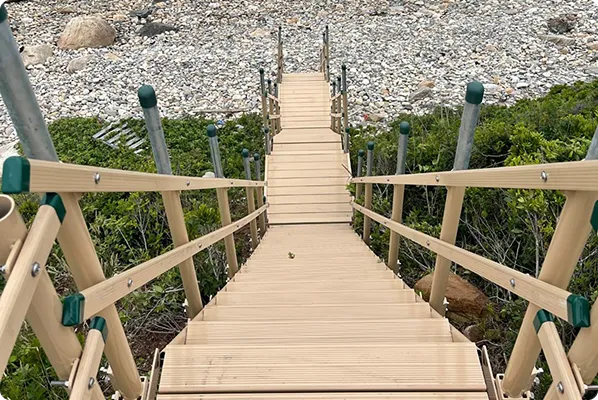
Dock Stairs for Steep Banks: Adjustable Aluminum Stairs
A bank that won't hold a straight stair
Most stairs are built for a slope that behaves. A shorefront bank does not. It changes pitch halfway down, it has ledge in it, and it moves a little every spring. A fixed-rise stair built for the average of that bank is wrong at both ends of it.
Alummikon stairs adjust. Every tread sets independently through a range, so one run follows the actual ground instead of forcing the ground to match the stair. That is why they go in on banks other stairs get turned down for.
How many steps does your bank need?
Measure your bank one of two ways: straight down from the top to the water line, or along the face of the slope. Either one works.
- Vertical drop: one tread every 7 inches. A 70-inch drop is 70 ÷ 7 = 10 steps.
- Along the slope: one tread every 13 inches. A 130-inch slope is 130 ÷ 13 = 10 steps.
The stairs adjust, so you can round up or down. That is the point of an adjustable tread: the bank does not have to cooperate with the math.
What you're getting
- Adjustable rise — treads set through a range instead of one fixed height
- 12-inch run and a 30-degree slope, so it walks like an ordinary stair, not a ladder
- 4 feet wide — wide enough to carry a cooler down without turning sideways
- Anti-slip surface, aluminum or Evernew treads
- Leveling legs at the bottom, and handrails if you want them
- Engineered design — stamped engineering is prepared per project by the engineer of record, Sullaway Engineering
- Standard runs are 5 or 8 steps; anything else is built to your bank
Specifications
| Spec | Value |
|---|---|
| Run | 12 in |
| Slope | 30° |
| Width | 4 ft |
| Rise | Adjustable |
| Standard run lengths | 5 or 8 steps; custom on request |
| Treads | Aluminum or Evernew, anti-slip |
| Handrails | Optional, square or round |
| Base | Leveling legs; driven pipe with pipe foot |
| Removable | Yes — no heavy equipment |
| Engineering | Stamped per project by the engineer of record |
It comes out the same way it went in
The whole assembly is removable, with no heavy equipment. The legs are driven pipe with a pipe foot at the bottom that spreads the load so the pipe doesn't sink in soft ground.
That matters for two reasons. The stair can reach sites a machine can't get to. And if the shoreline ever changes, the stair moves with it instead of being demolished.
The blizzard on Martha's Vineyard
In early 2026 a coastal blizzard took the bluff out from under one of our beach staircases and dropped the whole run onto the sand. The stair did not break.
It was taken apart, inspected, and put back together from the same components at the same site before the summer season. The loss was the bank eroding, not the stair failing. Aluminum survives the fall.
Frequently asked questions
How many steps do I need for my bank?
Measure the vertical drop from the top of your bank to the water and divide by 7. Or measure along the face of the slope and divide by 13. Either count gives you the number of treads. A 70-inch drop is about 10 steps; so is a 130-inch measurement down the slope.
Will they work on a bank that isn't a consistent slope?
Yes, that is what they are built for. Each tread adjusts independently, so one run follows ground that changes pitch partway down instead of needing an even grade.
How wide are the stairs?
Four feet — wide enough to carry gear down comfortably and to pass someone coming up.
Do they need a concrete footing?
No. The legs are driven pipe with a pipe foot that spreads the load, so the stair sits without pouring anything and without bringing heavy equipment onto the shoreline.
Can they be taken out?
Yes. The whole run comes apart and the pipe pulls, with no heavy equipment. That matters for seasonal removal and for shorelines where a permanent structure is hard to permit.
Do they need painting or staining?
No. Aluminum doesn't rot, split or rust, and it needs no coating.
Get your bank measured and your stair designed
The step count is the start. The rest — how the run breaks up, where the landings go, what the bottom sits on — comes off the actual site.
Talk to Alummikon: 207-600-2705 or alummikon.com/contact-us
