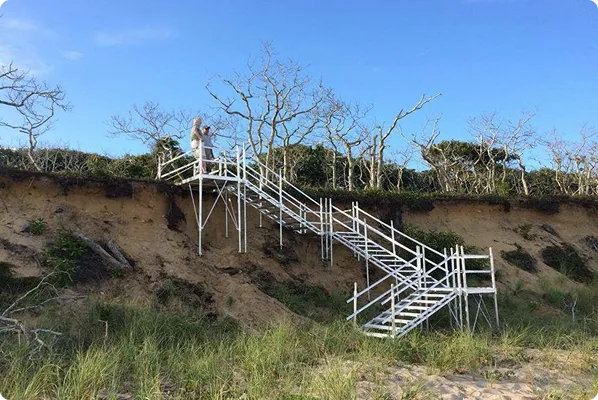
How to Size an All Terrain Stair: Treads, Rise and Run
How many treads does your bank need?
You can size an Alummikon All Terrain Stair from one measurement. Measure the bank one of two ways, divide, and round. Every tread sits on an adjustable rise, so the count fits the ground. You don't need it to be exact.
Two ways to measure
| Method | What to measure | Rule | Example |
|---|---|---|---|
| Vertical drop | Top of bank straight down to the bottom, in inches | Drop ÷ 7 in per tread | 70 in ÷ 7 = 10 treads |
| Diagonal slope | Distance along the face of the slope, in inches | Slope ÷ 13 in per tread | 130 in ÷ 13 = 10 treads |
Both rules come from Alummikon's own Stairway Formula Worksheet. Round either way; the adjustable tread takes up the difference.
Add the starter treads
Every run includes 2 starter treads, set level with the deck at the top and bottom. They are in addition to the count you calculated.
Check the rise per tread
Once you have a tread count, divide the vertical drop by it to get the rise each tread will be set to. With 70 inches of drop and 10 treads, each tread sits at a 7.0-inch rise — dead center of the stair's 4-to-9-inch adjustable range.
If the stair has to meet a building code, check that rise against the limit that applies:
| Check | Maximum rise per tread |
|---|---|
| Stair adjustment range | 4 in to 9 in |
| Residential (IRC) | 7¾ in |
| Commercial (IBC) | 7 in |
The diagonal-slope method gives you a tread count, not a rise. If the run needs a code check, confirm each tread's rise with the vertical-drop method.
Structure by run length
Structural specs are engineer-verified for runs of 2 to 22 treads. Reinforced treads sit at each upright; the rest are standard treads. Uprights are per side, on both sides of the stair.
| Treads | Reinforced treads | Standard treads | Uprights per side | Structure weight (lb) |
|---|---|---|---|---|
| 2 | 2 | 0 | 2 | 75.6 |
| 3 | 2 | 1 | 2 | 97.3 |
| 4 | 2 | 2 | 2 | 118.9 |
| 5 | 2 | 3 | 2 | 140.6 |
| 6 | 2 | 4 | 2 | 162.2 |
| 7 | 2 | 5 | 2 | 183.8 |
| 8 | 2 | 6 | 2 | 205.5 |
| 9 | 2 | 7 | 2 | 227.1 |
| 10 | 2 | 8 | 2 | 248.8 |
| 11 | 3 | 8 | 3 | 286.9 |
| 12 | 3 | 9 | 3 | 308.5 |
| 13 | 3 | 10 | 3 | 330.1 |
| 14 | 3 | 11 | 3 | 351.8 |
| 15 | 3 | 12 | 3 | 373.4 |
| 16 | 4 | 12 | 4 | 411.5 |
| 17 | 4 | 13 | 4 | 433.1 |
| 18 | 4 | 14 | 4 | 454.8 |
| 19 | 5 | 14 | 5 | 492.9 |
| 20 | 5 | 15 | 5 | 514.5 |
| 21 | 5 | 16 | 5 | 536.2 |
| 22 | 5 | 17 | 5 | 557.8 |
Runs outside 2 to 22 treads, or sites that need an engineering review, get a structural spec before quoting.
Frequently asked questions
How do I work out how many treads I need?
Measure the vertical drop of the bank in inches and divide by 7, or measure along the slope in inches and divide by 13. A 70-inch drop or a 130-inch slope both come out to 10 treads.
Does my measurement have to be exact?
No. Each tread adjusts through a 4-to-9-inch rise, so you can round the count up or down and the stair takes up the difference.
Are starter treads included in the count?
No. Every run includes 2 starter treads, set level with the deck at the top and bottom, in addition to the count you calculate.
Will my stair meet residential or commercial code?
Divide the vertical drop by the tread count to get the rise per tread. Residential (IRC) allows up to 7¾ inches; commercial (IBC) allows up to 7 inches. Add a tread if the rise comes out higher than the code you need to meet.
What if my bank needs more than 22 treads?
Structural specs are engineer-verified for 2 to 22 treads. Longer runs, or sites that need an engineering review, get a structural spec before quoting — call and we'll work it out.
Get your stair sized
Send us your bank measurement and we'll confirm the tread count, the rise and the structure for your site.
Talk to Alummikon: 207-600-2705 or alummikon.com/contact-us
